Chaos in 60 Seconds
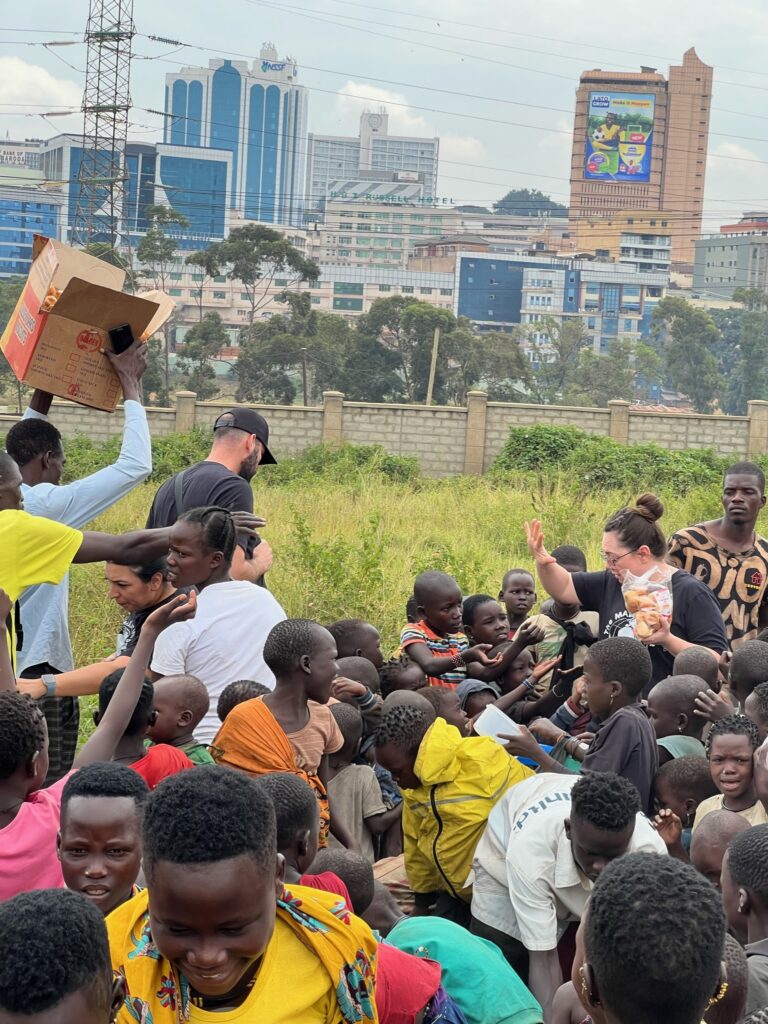
The bread was gone in seconds.
What started as an afternoon of worship and singing dissolved the moment we pulled the loaves from the box. Sixty, maybe seventy kids — some still babies, carried on the backs of children not much older — surged forward. Arms reaching, bodies pressing, the smallest ones disappearing into the crowd. We had come to feed them. Now I was terrified we were going to hurt them.
I looked at Moses. He had grown up in these streets. This was his church, his calling, his home. And even he looked as if he were calculating.
That was my second-to-last day in Uganda. But it’s the moment I keep coming back to, four years later, still.
That wasn’t my first impression of Uganda.
Two years earlier, I was sitting in my church on a normal Sunday when a mission trip video came on the screen. I don’t remember all of it. I just remember that something in me shifted. Was it the difference from everything I knew? The pull of the journey? Or was it God nudging me toward discomfort? I’ve come to believe it was the last one. I’m grateful either way.
It would still be two more years before I actually got on the plane to make the 9000-mile journey across the world.
When we landed in Entebbe, I was exhausted from travel, and I had no idea how God would use me and change me in this journey to Africa.
When we arrived at the school, I don’t think I had ever seen so many kids piled into one classroom. Desks that would seat maybe 2 kids here in America had 3-4 kids crammed into them, trying to get a glimpse of the visitors. In every classroom we walked into, the kids would greet us with “You are most welcome here, our dear visitors.” The kids back at home had well-lit classrooms, desks of their own, backpacks, school supplies, lunches, water bottles, and every other amenity they could ask for. While the kids at the school we were walking through appeared to have none of those things. But this did not stop them from putting a smile on their faces and greeting us as we walked past.
The funny thing about these kids is that they are the lucky ones. These kids are going to school; they have a roof over their heads, and they get at least a little food each day they attend school. In some cases, only one sibling in the family gets to attend school. Families can not afford to send multiple kids to school.
During this trip, we spoke to several students to get to know them better. Story after story, we heard about mom or dad or both dying in a car accident. Kids being kicked out of their own homes because their parents could not afford feed themselves and their kids. They were sent away to find a life without their parents, but it was schools like the one we were walking through that would help these kids wherever possible.
Through our days at the school, we became more comfortable with our surroundings and with the kids. The kids warmed up to us each and every day we were there visiting. I felt like I was making an impact while the kids were impacting me. I had prayed before the trip for God to use me in a way I didn’t understand, and in these days with the kids at school, I saw that. God was using me to show love to kids, teachers, and faculty halfway across the world. I was showing up dancing, laughing, and goofing around with these kids. I was doing God’s work, and I was proud of myself…
Just as fast as pride shows up, we can be humbled just as quickly.
Fast forward to the night before the slums. Our trip leader started a conversation with us at dinner. I don’t remember the exact conversation, but it was something to the effect of, ” The slums are evil, and we need to prepare ourselves and our hearts to go into the darkness like we are. We need to pray that God shows us the good and protects us as we go.” I had been in the slums of Mexico building houses, so I felt pretty confident in my strength.
I don’t think I have ever been more wrong.
Our plan for the morning was to feed the kids in the slums. We had sent money to some of the leaders of a kids ministry in the slums to purchase ingredients for porridge (water, sugar, flour) so we could feed them. We also wanted to stop at a local grocery store to pick up bread for the kids’ porridge. Once we found a store, we bought all the bread they had. I was excited to see the kids in the slums and get them some food.
We met up with Moses early the next morning. He was going to be our escort through the slums because this was his home. Moses, now an adult, grew up in the slums, and this was his community. Not only did Moses grow up here, but he stayed here to start a ministry for the kids in the slums. Showing these kids the good news of the Gospel and giving them hope.
As soon as we parked the car and walked onto the street leading into the slums in Kampala, I felt off. Something inside me was screaming that this is not a place I need to be. We had not even entered the village yet, and I was in disbelief about what I was seeing. Moses waved us over to meet him, and he started walking us through the village where his community lived. Where we were walking, there was no path. We walked beside and crossed over a stream of human waste. We passed by groups of people standing around, not doing much of anything. We saw women who were pregnant, we saw children taking care of children and babies with no mom or dad around. The only way I can explain what I felt that day is that it was evil. Our trip leader was right, the slums were filled with evil. Men who only knew how to take advantage of the less fortunate. As we passed by groups of people, we kept hearing them call out to us, saying “Mizungu,” which means white person in their language. The kids were excited to see the white people walking through their village, but the adults seemed less thrilled with the visitors. I did not feel safe, but at the same time, did not feel threatened.
We finally made our way to where the kids were gathered. As we were approaching the spot, we noticed kids running down the street with a bowl in hand. Surely the Mizungus brought them food. The time spent with the kids was amazing, but it all turned into chaos in an instant when we tried to hand out the bread we’d bought from the store. Each one of these kids has been forgotten or neglected by someone important in their life, and they have to fight for everything they receive. They were not going to let themselves be passed by for a slice of bread. In that instant, they were no longer a community but each person trying to get what was fair.
I have witnessed people going back into the slums a few different times since I have been back, and it is not easy to see. Most people I have served with break down in tears almost immediately when they see the poverty in this place. Poverty not like anything we have seen here at home. It hits us hard because our nation is wealthy. Not saying we do not have those in financial poverty close to us, but it is nothing compared to what other countries experience. It is actually this poverty that keeps me coming back to Uganda. When I visit, I often wonder if they see my poverty. No, I am not talking about financial poverty. I am talking about spiritual poverty. Do they feel bad for me and want to help me where I struggle? Even in those days I spent in the slums in Kampala, I saw an abundance of spiritual wealth. In the darkest place I have been, I see the light of Jesus shining through. Kids with their belly laughs, Moses preaching the gospel, and other adults serving as Jesus served. Most churches in Africa do not have the technology or buildings we have in our churches at home, but it is in these churches that I see God and feel my spiritual poverty cup being filled.
When I came home from my first trip, I could not point to any way God had changed my heart. It is only today, as I sit and write this, that I see the changes that have been made in my life. God has given me a passion for kids and for His Church around the world. It does not matter how many people are in the church or how big the building is; God is moving across the world, and I see that more than ever now. Uganda Play Project was born from this time in the slums. Kids all over the world never receive or own a single toy. Each one we make is meant to carry what I saw in that place — the light that was there even in the darkness. It is Uganda Play Project’s mission to bring that light, one toy at a time, to kids all over the world.